The Julián Álvarez Penalty: A Suspicious Video, and No Answers
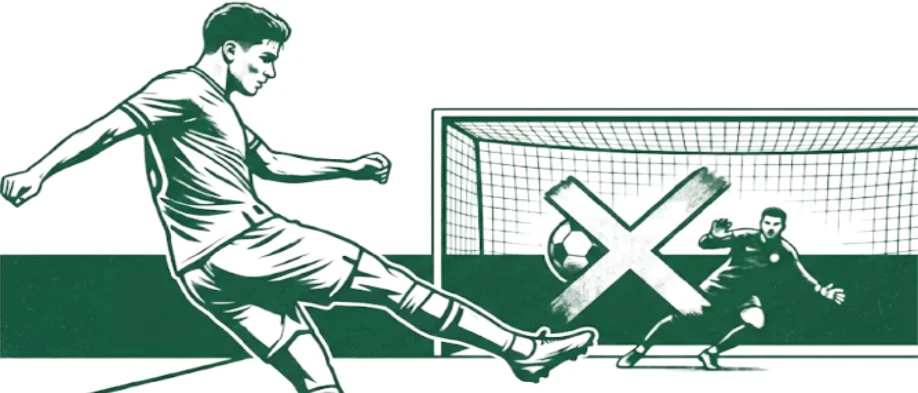
Julián Álvarez scored. The goal did not count. And then things got stranger.
What Happened
Champions League, Round of 16, 2024-25. Atlético Madrid vs Real Madrid. Two legs, two partial draws, 2-2 on aggregate. Penalties.
The shootout was 2-1 to Real Madrid when Álvarez stepped up. He hit it clean, it went in, the Metropolitano erupted.
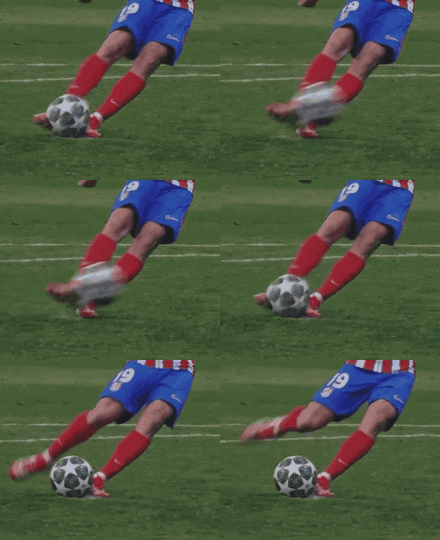
Then referee Szymon Marciniak ruled the goal out. The reason: double touch. According to the VAR team, Álvarez slipped and his standing foot made contact with the ball before he struck it with his right.
Atlético lost the shootout 4-2 and were eliminated.
What Simeone and Álvarez Said
Diego Simeone kept it short in the post-match press conference. "Who saw Julián touch the ball twice? Raise your hand. Come on, come on! Who is going to raise their hand? No one is raising their hand. Next question," he said, addressing the reporters in the room.
No journalist raised their hand.
Simeone also said: "When he plants his foot and kicks, the ball doesn't move even a little bit. But if VAR called it, I've never seen a penalty called by VAR, but it's still valid, and they'll have seen that he touched it. I want to believe they'll have seen that he touched it."
Álvarez said it himself days later, after an Argentina match: "I watched it a thousand times. I don't feel it. The rules need to be a bit clearer."
Real Madrid goalkeeper Thibaut Courtois said he had flagged it to the referee. "I felt that he touched the ball twice and I told the referee. It's not easy to see that. It was a bit of bad luck for them," he said, before adding: "I'm sick of this victimhood, always crying about things like this."
The Rule — And Why It Didn't Apply the Way They Used It
This is the part that matters most.
UEFA confirmed in their official statement: "Although minimal, the player made contact with the ball using his standing foot before kicking it. Under the current rule (Laws of the Game, Law 14.1), the VAR had to call the referee signalling that the goal should be disallowed. UEFA will enter discussions with FIFA and IFAB to determine whether the rule should be reviewed in cases where a double touch is clearly unintentional."
That last sentence is the tell. UEFA themselves immediately flagged that the rule needed reviewing — because they knew it had been applied to a situation it was never written for.
IFAB confirmed this in June 2025 when they changed the rule, stating explicitly: "This part of Law 14 is primarily intended for situations where the penalty taker deliberately touches the ball a second time before it has touched another player." An accidental slip, they said, "is not directly covered in Law 14."
The Athletic reported the exact wording from IFAB's new circular: "When the penalty taker accidentally kicks the ball with both feet simultaneously or the ball touches their non-kicking foot or leg immediately after the kick: if the kick is successful, it is retaken."
That is what should have happened in March. A retake. Not a disallowed goal. Not elimination.
Atlético's club statement put it plainly: "For us there is an error in the use of the VAR that has caused tremendous frustration and damage to our fans and the efforts of our players. We consider that there is no clear movement as indicated in rule 14 and that in 45 seconds you cannot resolve an action that more than a day later is still unclear."
The rule change came four months too late for Atlético.
The Video UEFA Published — And What Forensic Analysis Found
Hours after the match, UEFA published a video clip intended to show the double touch clearly. For many, it raised more questions than it answered.
Two independent groups of Atlético fans decided not to just argue about it online. They paid for forensic analysis out of their own pockets.
The Unión Internacional de Peñas del Atlético de Madrid commissioned the Laboratorio de Informática Forense Europeo (LIFe). Their 64-page report concluded that "the video provided by UEFA is not an original video obtained from a camera", citing: inconsistency in the metadata, an internal structure that does not match camera recordings, and no cryptographic signature certifying its originality.
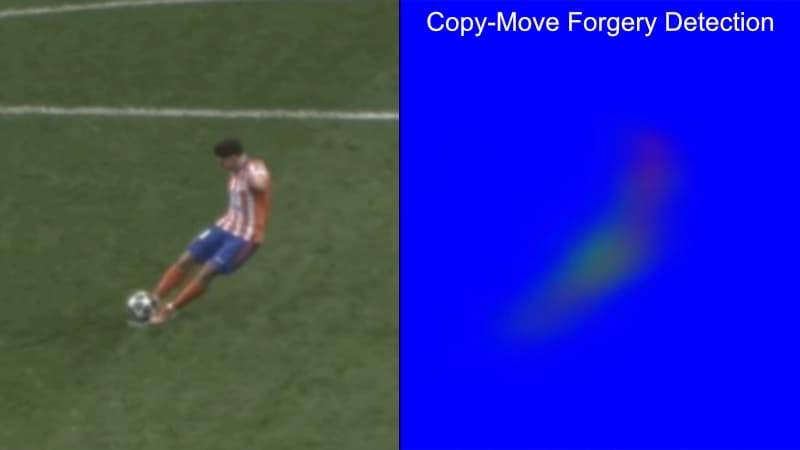
The LIFe report went further than metadata. Analysts applied a Copy-Move Forgery Detection (CMFD) filter — a forensic technique that scans for pixel regions that have been duplicated within the same image — to individual frames of the UEFA video using the Google InVID WeVerify Vera AI extension. In frame 60, the figure of Julián Álvarez is highlighted in white. In forensic terms, that means the tool detected a copy.
The fan collective Señales de Humo separately commissioned the firm Duque & Wittnak. Their conclusion: "The results of the forensic analysis do not rule out that the aforementioned video has been edited and, therefore, manipulated with respect to the original."
Tribuna reported the technical detail: "the analyzed file does not contain essential or original metadata from the VAR, there is no hash or cryptographic signature that certifies its originality and its technical parameters are discordant with those of the Video Assistant Referee system."
None of this proves manipulation. But none of it proves the video is the original VAR footage either. And UEFA used it as the official justification for eliminating a club from the Champions League.
What the Fans Did Next
Four supporter groups — the Unión Internacional de Peñas, Senado Atlético, Los 50, and Señales de Humo — announced joint legal action against UEFA.
Their demand was specific: the original, unedited VAR video, and the audio recordings from the referee and VAR team during the incident. Not a clip. Not a summary. The raw material.
Meanwhile, Atlético filed a formal complaint against four Real Madrid players — Mbappé, Vinícius, Rüdiger, and Ceballos — for their behaviour during the post-match celebrations. UEFA confirmed it opened an investigation.
UEFA did not release the original video. UEFA did not release the audio. What UEFA did was change the rule.
Where It Stands
IFAB's rule clarification (Circular 31), effective June 3, 2025, means that what happened to Álvarez cannot happen to another player in the same circumstances. The rule was applied for the first time during England's win at Women's EURO 2025.
That is a direct consequence of what happened at the Metropolitano. IFAB do not change rules for no reason.
The fans who paid for forensic reports are still waiting for the original footage. The lawyers are still working. Real Madrid are still in the competition Atlético were eliminated from.
And UEFA has never explained why the video they published doesn't have the metadata of an original VAR file.
If you have information about this case or witnessed something similar, submit your story here.